

Adoption of In-Place Pod Resource Updates in Gardener
As Kubernetes workloads evolve, the need for dynamic resource adjustments becomes increasingly critical. Traditional Pod resource updates require Pod recreation, leading to increased operational costs and potential service disruptions. To address this shortcoming, Kubernetes introduced a new way of updating Pod resources in-place, without the need to evict workloads in order to apply the configuration change. With the v1.27 release, a new resize subresource got introduced to the Pod's API, acting as an interface to the underlying CRI implementations that manage the cgroups settings.
What are the key benefits of in-place Pod resource updates?
Having the ability to bypass the rollout process when updating Pod resources drastically improves the scaling efficiency. Eliminating the overhead of Pod scheduling and application initialization is among the primary benefits of the new update mechanism. The following points summarize the key factors when considering using in-place updates:
- Zero-downtime scaling: Resources are adjusted without
Podrecreation or service interruption - Reduced scheduling overhead: No need to re-schedule
Pods across the cluster - Reduced initialization overhead: Applications do not go through full initialization all over again
- Preserved
Podidentity:Podnames, IPs, and volumes remain unchanged - Improved resource efficiency: More granular and responsive resource optimization
To read more about the feature, refer to the official documentation.
How does Gardener utilize the new update mechanism?
Gardener relies heavily on the Vertical Pod Autoscaler to advance the resource usage optimization and keep the out-of-the-box components running as efficiently as possible. With the v1.4.0 release, Vertical Pod Autoscaler introduced the ability to configure a new .spec.updatePolicy.updateMode for the VerticalPodAutoscaler resources:
apiVersion: autoscaling.k8s.io/v1
kind: VerticalPodAutoscaler
metadata:
  name: demo-vpa
spec:
  targetRef:
    apiVersion: "apps/v1"
    kind:       Deployment
    name:       demo
  updatePolicy:
    updateMode: "InPlaceOrRecreate"
effectively performing in-place resource updates and falling back to eviction in case of failure. Adopting this release created the opportunity to leverage the new update mechanism, and with Gardener v1.137, a new automatic migration mechanism was introduced.
Historically, VerticalPodAutoscaler resources, created for the different Gardener components, were configured to use update mode Auto as it was the default option that mimics the behavior of Recreate - evicting Pods to apply newly calculated resource recommendations. The subsequent Vertical Pod Autoscaler v1.5.0 release deprecated the Auto update mode, leaving only two viable options for continuous scaling: Recreate and InPlaceOrRecreate. The following graph illustrates the flow of Pod resource updates used in Gardener:
The key functionality behind this improved resource management is Linux cgroups, which are responsible for grouping processes and limiting the host resources they can utilize.
How are VerticalPodAutoscaler resources configured?
Like any cluster-wide configuration change, migrating the VerticalPodAutoscaler resources' update mode presented a unique challenge that solved this by leveraging the Gardener Resource Manager and its extensible architecture.
We developed a dedicated MutatingWebhook that automatically filters relevant VerticalPodAutoscaler resources and applies the update mode change, making the migration seamless. The webhook is deployed through the VPAInPlaceUpdates feature gate, available in both gardenlet and Gardener Operator. In case the feature gate gets disabled, there is also a rollback mechanism, present in both components. During the initialization of either the gardenlet or the Gardener operator, the update mode gets automatically reverted. These changes have been available since Gardener v1.137, making in-place update mode adoption fully operational and ready for production use.
For detailed information on usage and enablement, refer to the official documentation.
How does Gardener benefit from the in-place Pod resource updates adoption ?
Apart from the above-mentioned advantages of using in-place resource updates, adopting the mechanism allows mitigation of a few shortcomings that have the potential to cause severe troubles. Since Gardener offers the ability to configure non-HA Shoot clusters, their etcd data stores become vulnerable to restarts. Having a VerticalPodAutoscaler resource with an update mode Recreate, referencing a single-node etcd store, causes a short control plane downtime each time the recommender decides to apply new resource values. An identical situation can be witnessed in the Gardener monitoring and logging stacks, where Prometheus and Vali run as single-instances, facing the single-node etcd problem when evicted.
Another good example of a Kubernetes flaw that could have been resolved by using in-place resources update mode has to do with the kube-scheduler and its prior behavior of getting Pods, with volumes, scheduled on Nodes that have already reached their volume attachment limit. Documented in a dedicated Kubernetes issue, this problem had appeared when the CSI Node plugin Pod gets restarted during eviction, exactly how VPA was configured to do at the time of reporting it. During the gap between the deletion and the new Pod creation, the CSINode object temporarily has an empty drivers section. The kube-scheduler's NodeVolumeLimits plugin treated this missing information as "no limit" and incorrectly scheduled volume-backed pods to fully-saturated Nodes.
The impact of adopting in-place resource updates is best illustrated by the numbers: enabling the feature on the Seed clusters and the runtime cluster results in roughly 98% of the Pod resource updates being applied in-place, drastically reducing the amount of disruptive Pod recreations across the Gardener landscape. The exact ratio may vary from one Seed or runtime cluster to another, depending on its configuration.
Monitoring
Performing configuration migrations can become an exhausting task without a convenient dashboard to evaluate the process state. For this reason, as part of the effort to support in-place Pod resource updates, we introduced a brand new dashboard for the vpa-updater component.
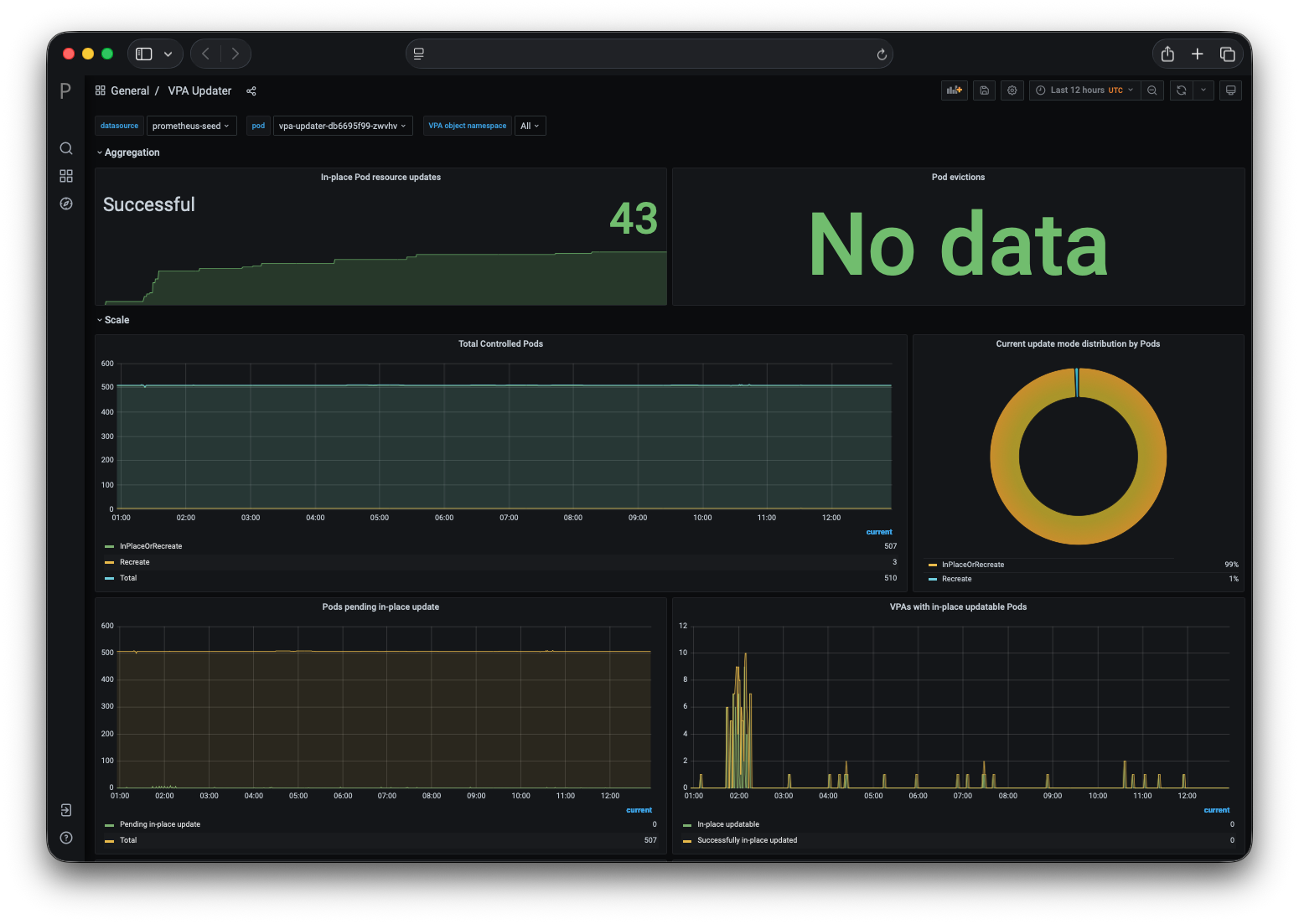
With sections covering VerticalPodAutoscaler resource overviews (segregated by update mode) and panels displaying success rates per resource, the new dashboard can be used for both monitoring and generating status reports on applied resource recommendations.
References
- In-Place Pod Resize (GA in v1.35)
- Resize Container Resources
- Pod v1 API Reference - resize subresource
- VPA v1.4.0 Release Notes (introduces update mode
InPlaceOrRecreate) - VPA v1.5.0 Release Notes (deprecates update mode
Auto) - VPA In-Place Updates Documentation
- Gardener Usage: In-Place Resource Updates
- Gardener Operations: Enabling In-Place Resource Updates
- Gardener Resource Manager
- Gardener v1.137
- Linux cgroups v2
- CRI (Container Runtime Interface) Specification