
GEP-0043: Spegel Registry Support in the registry-cache extension
Summary
This proposal introduces a new extension type registry-spegel to the gardener-extension-registry-cache extension. When enabled in the Shoot specification, it will install Spegel local registry mirror on the Shoot cluster nodes. Gardener operators should be able to enable registry-spegel extension type globally for all Shoots in a Gardener landscape. The local Spegel registry is able to mirror all container images pulled by the kubelet.
Motivation
The current solution for image cache is based on Distribution project's pull-through cache.
The Problem
The registry cache extension is not widely adopted in some Gardener landscapes, and not all used upstreams are covered by the extension's configurations. This is likely due to:
- Explicit and non-trivial configuration: A separate configuration needs to be set for each upstream registry.
- Additional resources: A StatefulSet is created for each of the configured upstream. The PV size (defaults to 10Gi) should be monitored and increased if necessary, otherwise the cache becomes ineffective.
- Limitations:
- It is not possible to cache most of images from the pods in the
kube-systemnamespace, as the cache can be used only after its Kubernetes service can be accessed from the host (i.e., after service routing was implemented, e.g. by kube-proxy configuring iptables/IPVS rules). - Only one set of upstream credentials is supported, therefore some private images cannot be cached.
- Amazon ECR mirroring is not supported - ref.
- Dynatrace registry mirroring is not effective, as incorrect
Content-Length: 0header is returned for most of the image layers. - It is not possible to mirror private registries authenticated with a kubelet image credential provider - ref.
- Registry pods scaling is challenging and resource consuming.
- TTL garbage collection setting is inefficient because it is not extended on access. Hence, an image is always deleted from the cache when its TTL expires, and will be re-pulled from upstream if requested again.
- It is not possible to cache most of images from the pods in the
Why Should We Care
Because the registry-cache cannot be enabled globally and not all upstream registries are covered, downloading images results in significant egress network traffic costs. Additionally, there are costs for outbound traffic from image registries like Amazon Elastic Container Registry, Google Cloud Artifact Registry, and Azure Container Registry. Even if the pull-through cache is configured, there are also costs for cross zonal traffic within the Shoot cluster.
Providing a peer-to-peer (p2p) image caching solution that is enabled by default and spans all upstream registries will reduce both cloud costs and image pull latency.
Who Benefits
- End users benefit from the reduced latency when pulling images.
- Stakeholders see reduced costs for egress network and registries.
- Gardener operators are no longer engaged in monitoring notifications of PV sizes in the registry caches.
Goals
- Introduce a new
registry-spegelextension type that installs Spegel local registry mirror on the Shoot cluster nodes. - Allow operators to enable
registry-spegelextension type globally for all Shoots in a Gardener landscape. - All container images pulled by the kubelet should go through the Spegel registry mirror.
Non-Goals
registry-spegelis not a replacement for the existingregistry-cacheandregistry-mirrorextension types, and they can be configured together in a containerdhosts.tomlfile:tomlserver = "https://registry-1.docker.io" [host."http://<node-internal-ip>:15500"] capabilities = ["pull", "resolve"] [host."https://<docker-registry-service-ip>:5000"] capabilities = ["pull","resolve"] ca = ["/etc/containerd/certs.d/ca-bundle.pem"]- Support for topology-aware routing to reduce cross-zonal traffic is part of future enhancements.
- Container images pulled by the
gardener-node-init.serviceviactrcli andcontainerdclient will not use Spegel, as is not yet available at this time. The following images cannot be covered by Spegel:- gardener-node-agent
- hyperkube
- opentelemetry-collector / valitail
- spegel
- other images used in
OperatingSystemConfigreferenced viaspec.files[].content.imageRef
Proposal
The proposal is to extend the existing registry-cache extension with a p2p image cache based on Spegel. A new extension type registry-spegel is introduced to configure Spegel registry in the _default mirror configuration in containerd. Gardener operators should be able to enable the extension globally, i.e. enable for all Shoot in a Gardener landscape.
Introduction
A brief overview of the components used in this proposal.
Spegel Overview
Spegel is a p2p image cache. It runs a local image registry on each node in a Kubernetes cluster. The local registry subscribes for containerd's image related events and serves image blobs and manifests that are available in the containerd image store. The content discovery in a Kubernetes cluster is based on Kademlia DHT. When an image content (blob, manifest or index) is available in the containerd image store, Spegel adds its digest to the DHT provider store, announcing that the node provides the content corresponding to the digest. Then, when the same digest is needed by another node, Spegel searches the DHT for peers that provide the content and pulls it from them.
The straightforward way to deploy Spegel to a Kubernetes cluster is by using the provided helm chart. However, this has some drawbacks when a new node joins the cluster. Our goal is to be able to use Spegel for all images pulled from the kubelet, including the registry.k8s.io/pause image. Therefore we will run Spegel registry as a systemd unit service on the host. The existing HTTP bootstrapper will be used with configured mTLS authentication with Spegel bootstrapper server.
Kademlia Distributed Hash Table Overview
An overview of Kademlia Distributed Hash Table is available here.
Registry Spegel API Design
The registry-spegel API design is simple and provides options to overwrite default values for Spegel's registryPort, libp2p routerPort, metricsPort and resolveTags.
// SpegelConfig contains information about the Spegel listening addresses of each Node.
type SpegelConfig struct {
	metav1.TypeMeta `json:",inline"`

	// RegistryPort is the port that serves the OCI registry on each Node.
	// `registryPort` should be a valid port number (1-65535, inclusive).
	// Defaults to 15500.
	// +optional
	RegistryPort *int32 `json:"registryPort,omitempty"`
	// RouterPort is the port for P2P router on each Node.
	// `routerPort` should be a valid port number (1-65535, inclusive).
	// Defaults to 15501.
	// +optional
	RouterPort *int32 `json:"routerPort,omitempty"`
	// MetricsPort is the metrics port on each Node.
	// `metricsPort` should be a valid port number (1-65535, inclusive).
	// Defaults to 19090.
	// +optional
	MetricsPort *int32 `json:"metricsPort,omitempty"`
	// ResolveTags describes whether Spegel will resolve tags to digests.
	// Defaults to true.
	// +optional
	ResolveTags *bool `json:"resolveTags,omitempty"`
}
Architecture Overview
The registry-spegel extension type will support being enabled by default in the operator.gardener.cloud/v1alpha1.Extension resource:
apiVersion: operator.gardener.cloud/v1alpha1
kind: Extension
metadata:
  name: extension-registry-cache
  annotations:
    security.gardener.cloud/pod-security-enforce: baseline
spec:
  resources:
  - kind: Extension
    type: registry-spegel
    autoEnable: [shoot]
    clusterCompatibility: [shoot]
  - kind: Extension
    type: registry-cache
    clusterCompatibility: [shoot]
  - kind: Extension
    type: registry-mirror
    clusterCompatibility: [shoot]
...
Spegel bootstrapper is deployed into the Shoot namespace in the Seed cluster. In the Shoot cluster nodes the containerd, spegel, and kubelet systemd units are started. When spegel is starting, it gets the bootstrap peers from the bootstrapper and registers for image related events in containerd. It also lists existing content in the image store and advertises it to the DHT.
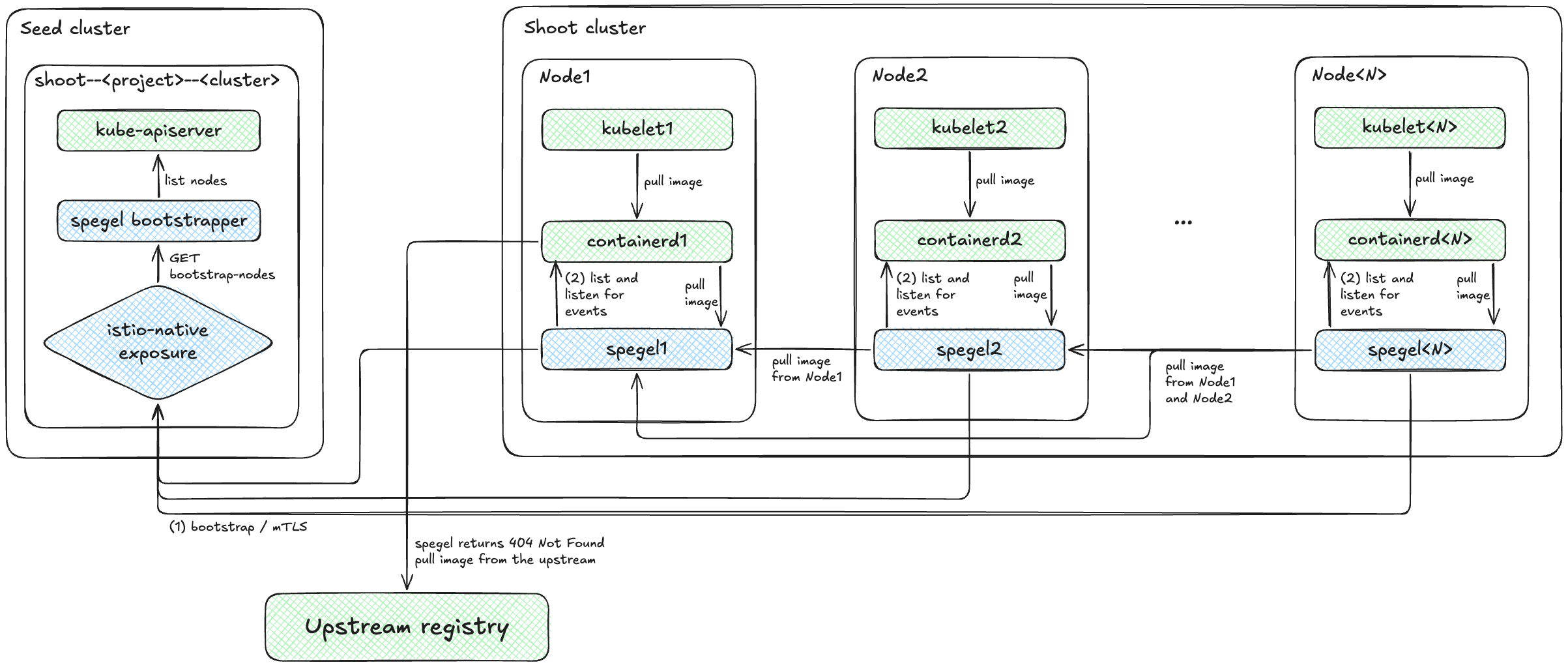
Let kubelet1 on Node1 pull an image. It sends a CRI PullImage request to containerd1. Then containerd1 checks the mirror configuration in hosts.toml and sends a request to the local spegel1 registry. The image doesn't exists on any node, so 404 NotFound is returned. The containerd1 then pulls the image from the upstream and fires /images/create and /content/create events. Events are processed by spegel1 and it is added as a content provider to the DHT for the image. Let kubelet2 on Node2 pull the same image. In this case, spegel2 looks up the image content in the DHT and finds that the content is available on Node1. It then fetches the contents from the spegel1 registry on Node1 and streams it directly into the response to containerd2. The containerd2 then fires the image events and spegel2 added itself as a content provider to the DHT. Finally, let kubelet<N> on Node<N> pull the same image. Here, when spegel<N> looks for content, it finds that it is available on Node1 and Node2. It will then fetch some layers from Node1 and some from Node2.
Spegel Binary and Systemd Unit
The spegel binary will be provided to the node in the /opt/bin/ folder via an OperatingSystemConfig mutation. The same approach is used for spegel.service systemd unit that depends on containerd service and must be started before the kubelet service:
[Unit]
Description=spegel daemon
Documentation=https://github.com/spegel-org/spegel
After=containerd.service
Requires=containerd.service
Before=kubelet.service
[Install]
WantedBy=multi-user.target
[Service]
Restart=always
RestartSec=5
MemoryHigh=80M
MemoryMax=100M
ExecStartPre=/bin/sh -c 'sed -i "s/<<HOST_IP>>/$(hostname -i)/g" /var/lib/spegel/env'
ExecStartPre=/bin/sh -c 'find /etc/containerd/certs.d -type f -name "*.toml" | xargs sed -i "s/<<HOST_IP>>/$(hostname -i)/g"'
EnvironmentFile=/var/lib/spegel/env
ExecStart=/opt/bin/spegel \
    registry \
    --log-level=INFO \
    --mirror-resolve-retries=3 \
    --mirror-resolve-timeout=20ms \
    --registry-addr=${HOST_IP}:15500 \
    --router-addr=${HOST_IP}:15501 \
    --metrics-addr=${HOST_IP}:19090 \
    --containerd-sock=/run/containerd/containerd.sock \
    --containerd-namespace=k8s.io \
    --bootstrap-kind=http \
    --http-bootstrap-url=https://<spegel_bootstrapper_domain_name>/bootstrap-nodes \
    --http-bootstrap-cert-dir=/var/lib/spegel/certs \
    --containerd-content-path=/var/lib/containerd/io.containerd.content.v1.content
The certificates used for mTLS with Bootstrapper are also provided in the /var/lib/spegel/certs folder via the OperatingSystemConfig resource.
Containerd Configuration
The registry-spegel extension ensures that the discard_unpacked_layers setting is set to false. This is done via the CRIConfig.Containerd.Plugins field in the OperatingSystemConfig resource. If the value is true the image layers are deleted after unpacking and Spegel cannot serve the content. For details, see Spegel compatibility. discard_unpacked_layers is false by default on gardenlinux:
$ cat /etc/containerd/config.toml
disabled_plugins = []
...
version = 3
...
[plugins]

  [plugins."io.containerd.cri.v1.images"]
    concurrent_layer_fetch_buffer = 0
    disable_snapshot_annotations = true
    discard_unpacked_layers = false
...
The registry-spegel extension will configure the containerd with a _default mirror configuration for the local spegel registry:
$ tree /etc/containerd/certs.d
/etc/containerd/certs.d
└── _default
    └── hosts.toml

$ cat /etc/containerd/certs.d/_default/hosts.toml
# managed by gardener-node-agent
[host."http://<node-internal-ip>:15500"]
  capabilities = ["pull", "resolve"]
For existing mirror configurations (e.g., provided by registry-cache and image-rewriter extensions) it will inject the local spegel registry as a first host entry in the hosts.toml file. This will be done via the mutation of the CRIConfig.Containerd.Registries field in OperatingSystemConfig resource and requires also a change in the components that mutate registry configurations (via webhooks) to respect this change.
Spegel Bootstrapper
In the Shoot control plane a Spegel bootstrapper is provided. It consists of:
- Deployment
- Service
- Istio VirtualService and Gateway
The spegel registries send a GET request to https://<spegel_bootstrapper_domain_name>/bootstrap-nodes to get the bootstrap peers. Traffic is encrypted and authenticated using mTLS. The bootstrapper uses client-go to access the kube-apiserver and lists the Kubernetes nodes. It sorts the nodes and returns a subset of the first few node net.IPAddr addresses, similar to what is done in DNSBootstrapper.
Observability and Monitoring
The spegel registry exposes the following noticeable metrics:
http_response_size_bytes- The size of the HTTP responses - histogram type.http_request_duration_seconds- The latency of the HTTP requests - histogram type.spegel_mirror_requests_total- Total number of mirror requests - counter type.spegel_resolve_duration_seconds- The duration for router to resolve a peer - histogram type.spegel_advertised_keys- Number of keys advertised to be available - gauge type.
With these metrics, Spegel cache's efficiency can be tracked. In the PoC branch, a sample dashboard is created.
Future Enhancement
In the Network topology awareness issue there are options to implement zone aware routing (e.g., enhance Kademlia DHT with Soft Partitioning).
A simple approach was tested locally on GCP infrastructure. When the content is available on the node, it registers <digest> and <zone><digest> as keys in the DHT. The disadvantage of this approach, besides duplication of keys, is that when searching for content, the <zone><digest> key is tried first, and if not enough peers providing the content are found, a new search is performed for the <digest> key.
Proof of Concept
There is PoC of the above proposal available here:
Impact and Alternatives
Risks, Downsides and Trade-offs
Images not covered by Spegel: Images pulled by the
gardener-node-init.servicevia thectrCLI / containerd client (e.g.gardener-node-agent,hyperkube,opentelemetry-collector/valitail,spegelitself, and images referenced viaspec.files[].content.imageRefin theOperatingSystemConfig) are pulled before Spegel is available and therefore always come from the upstream. See Non-Goals.Increased root disk usage: To be able to serve image layers to peers, Spegel requires containerd's
discard_unpacked_layerssetting to befalse. On systems where this setting defaults totrue, enablingregistry-spegelwill retain the compressed layer blobs on the node's root disk after unpacking, thus increasing the root disk usage. Spegel serves directly from containerd's content store - but it does prevent the space reclamation thatdiscard_unpacked_layers = truewould otherwise perform. On Garden Linux this setting is alreadyfalseby default, so there is no change. This trade-off should be clearly documented for users so it does not come as a surprise.Increased memory usage on the nodes: Running Spegel as a systemd unit on every node adds a resident process that consumes memory (for the libp2p host, the Kademlia DHT routing table, and the advertised content records). The
spegel.serviceunit constrains this viaMemoryHigh=80MandMemoryMax=100M, so a node's available memory is reduced accordingly. As this memory is consumed on the host and not by a Kubernetes pod, it is not reflected in the node's kube-reserved/system-reserved and is therefore not visible as a scheduling reservation.
Alternative approaches
Spegel as a DaemonSet
The straightforward way to deploy Spegel is to use upstream Helm chart and deploy it as a DaemonSet. This variant was implemented and tested as a PoC using the upstream DNS bootstrapper (PoC), which works out of the box.
Pros:
- Improved visibility in Kubernetes: native monitoring, debugging (
kubectl logs), autoscaling and resource reservation.
Cons:
- Does not cover most images in the
kube-systemnamespace, because the Spegel pod (and, for the DNS bootstrapper,kube-dns) must be running before it can serve content. Images pulled during node bootstrap - measured at roughly200MiBper node are pulled from the upstream instead of from a peer. - Like the systemd approach, it does not cover images pulled by the
gardener-node-agent.
The systemd-unit approach was preferred because it covers all images pulled by the kubelet, including images from the kube-system namespace, which is where a significant share of the traffic savings comes from. The visibility trade-off is mitigated by the Gardener observability stack (metrics scraping and journald log collection via the OpenTelemetry Collector).
Dragonfly
Dragonfly was evaluated as an alternative. Unlike Spegel, it is not stateless and requires central components such as:
- manager - to manage the p2p network.
- scheduler - for optimal parent peer selection.
They require mysql and redis storages. Another disadvantage is the additional image store on the node's root disk.
Appendix (Optional)
Kademlia Distributed Hash Table
Kademlia DHT is part of libp2p library and is used by Spegel for peer routing and content provider advertisement and discovery. A unique 256 bits ID is generated for each peer node (this is the Ed25519 public key in Spegel case). Based on the node ID, a routing table consisting of k-Buckets is maintained. Peers nodes are placed into k-Buckets based on how similar their IDs are to the local node's ID, using XOR distance to measure proximity.
An example with 4 bits ID 0110 there will be 4 buckets for prefixes 1xxx (distance >= 8), 00xx (distance in [4,5,6,7]), 010x (distance in [2,3]) and 0111 (distance = 1)
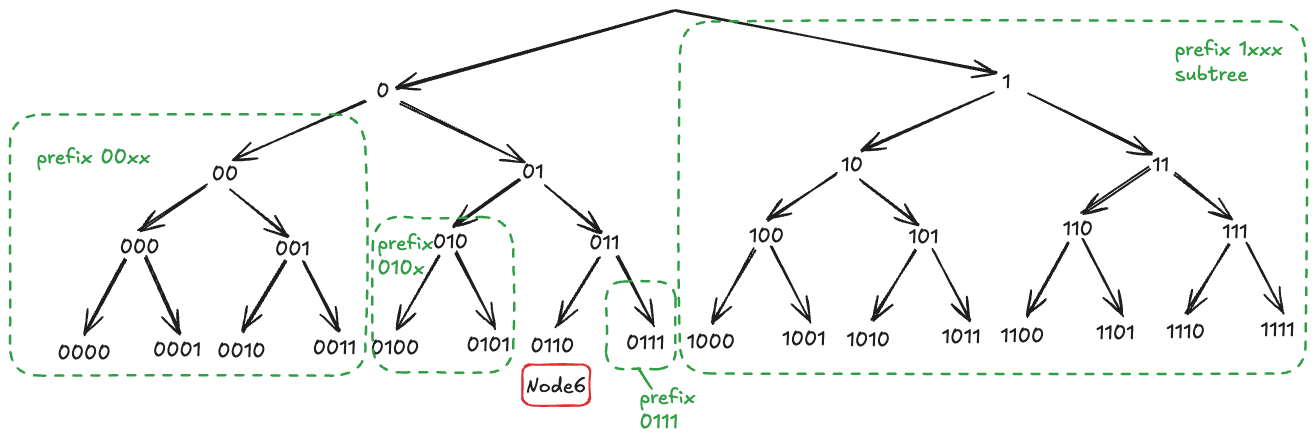
For each prefix, at most k nodes are included. The default value for k is 20.
When a node joins the cluster, it must know the address of at least one peer (also known as bootstrap peer). The new node connects to the bootstrap peers and adds them to the routing table. It sends FIND_NODE to bootstrap nodes for its own ID and receive information for the k closest nodes, adding them to the routing table. The new node then sends FIND_NODE to the appropriate peers in the routing table for random keys within ranges corresponding to its empty k-Buckets. During the peer connection process, other peers may add the new node ID to their routing tables.
When an image, manifest, or blob becomes available on a node, it sends an ADD_PROVIDER message to the k peers that are closest to the content digest. Then, if the digest is needed by another node, it sends a GET_PROVIDERS message to the peers closest to the digest and receives a set of peers that provides the content.
Supporting Materials (Linked or Embedded)
- Spegel
- Setup Default Mirror for All Registries
- Content provider routing
- Kademlia DHT
- Kademlia DHT Message Types
- Dragonfly